For most growing food, beverage and consumer products brands, the fastest path to more profit is not another SKU, another flavor or another channel. It is deciding what to stop. Subtraction, done with discipline, is a growth strategy.
One small story from the first week of October 2026 caught my eye. RIND Snacks closed its online store, narrowed its focus to its Apple Chips and cut its SKU count so it could simplify operations and put more resources into manufacturing (Nosh, October 5, 2026). The same week, Stride acquired Clio, a brand built around one product idea, the Greek yogurt bar, that reached 60,000 retail locations (Nosh, October 4, 2026).
Two very different outcomes, one shared lesson. Focus is not a constraint on growth. In my experience as a fractional CEO and COO, it is usually the thing that makes growth possible.
Why do more SKUs and channels so often mean less profit?
More SKUs and channels mean less profit when each new item adds cost faster than it adds sales. Every new flavor, pack size or channel looks small on its own. Together, they slowly drain margin, cash and team attention.
The pattern is well documented. In a typical line of 8 to 10 SKUs, the top 2 or 3 can drive up to 80% of sales (Just Drinks via Yahoo Finance, 2024). McKinsey found that one food manufacturer grew its SKU count by 66% over three years while sales per SKU fell by 40%. After cutting SKUs by 25%, the same business raised gross margin by 2 to 4 points (McKinsey, 2016).
The largest companies are acting on it now. BCG’s 2026 guidance to consumer CEOs is blunt: rationalize the long tail and focus on high-impact core items (BCG, 2026). If Unilever and Nestle are pruning, a $20 million brand with a fraction of their scale has even less room to carry products that do not earn their place.
Why do founders keep adding anyway? Because a new SKU feels like progress. A buyer asks for it, a loud customer requests it or the team needs something new to talk about. Nobody gets credit for the launch that did not happen, so complexity piles up by default.
The four hidden costs of complexity
Complexity rarely shows up as a single line on the P&L. It hides in four places, and most founders only see the first one.
1. Operations cost. Every extra SKU means more changeovers at the co-manufacturer, more minimum order quantities for ingredients and packaging, more forecasting and more chances to run out of the items that matter. Short runs cost more per unit, and those costs land on your best sellers too.
2. Cash. Slow-moving SKUs tie up cash in inventory that ages on a warehouse shelf. For an emerging brand, that is cash that should be funding trial and promotion behind the products that actually sell.
3. Channel cost-to-serve. Each channel has its own economics. A direct-to-consumer site needs paid media, fulfillment, customer service and a technology stack. Club, natural, conventional and Amazon each need their own pack, pricing and team time. A channel can grow revenue and still lose money once you load in everything it takes to serve it.
4. Focus. This is the most expensive cost and the hardest to measure. A small team split across 30 SKUs and five channels cannot do any of them well. The brand loses its clear story, retailers see a scattered set, and shoppers have a harder time finding the item they came for.
How do you decide which SKUs and channels to cut? The Five Cut Tests
The best way to decide what to cut is to run every SKU and every channel through the same five tests, using real numbers instead of opinions. I call them the Five Cut Tests. An item that fails two or more is a strong candidate to go.
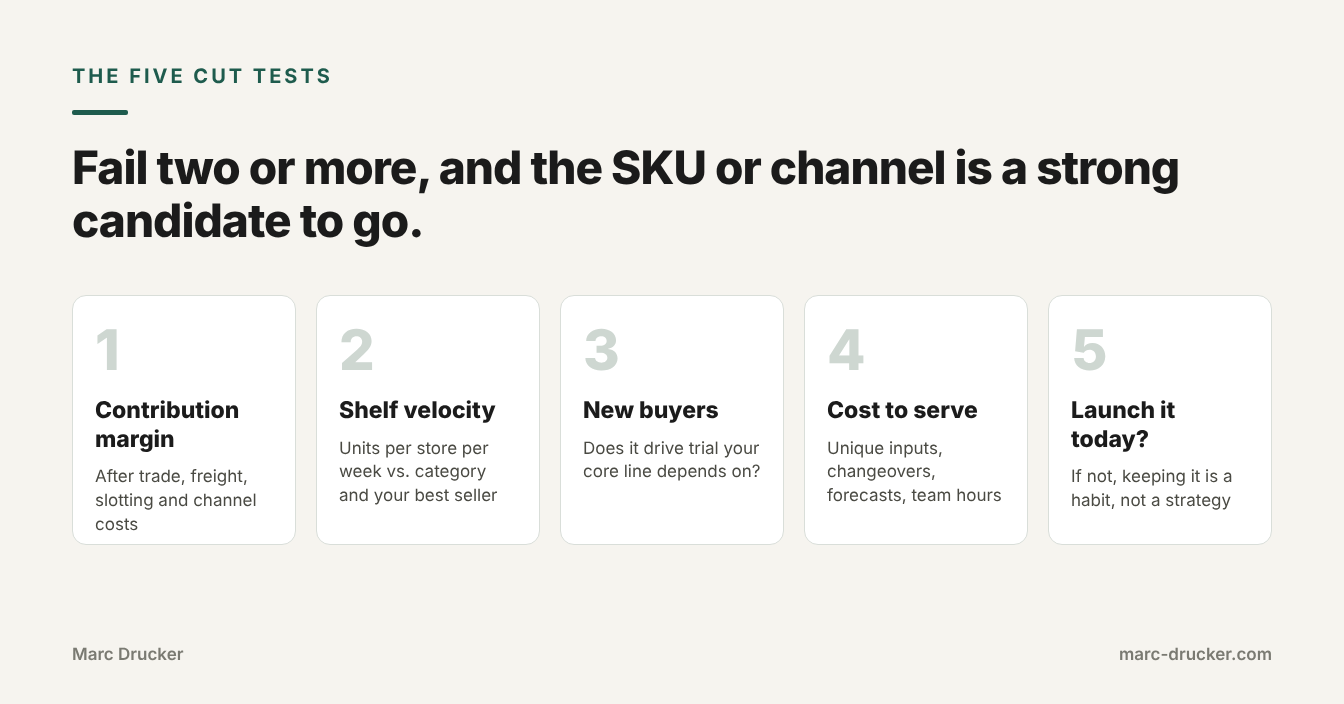
Test 1: Does it earn its contribution margin? Look past gross margin. Take each SKU’s revenue and subtract cost of goods, trade spend, freight, slotting and any channel-specific costs. Many brands discover that a product they love is losing money on every case once trade and freight are counted.
Test 2: Does it move at the shelf? Compare each SKU’s velocity, its units per store per week, to the category average and to your own best seller. Retailers are running this test whether you do or not. A slow SKU is often the first item cut at the next reset, and it can drag the rest of your set down with it.
Test 3: Does it bring in new buyers? Some items look weak on their own but bring in shoppers who go on to buy your core line. Before cutting, check whether the SKU drives trial or repeat that the rest of the portfolio depends on. If it does not, it is not a gateway. It is a distraction.
Test 4: What does it cost to serve? Add up the hidden operational load: unique ingredients, unique packaging, extra production changeovers, separate forecasts and the team hours it takes. A channel gets the same test. Count paid media, fulfillment, returns, customer service and software, not only revenue.
Test 5: Would we launch it today? This is the gut-check test. Knowing what you know now about the item’s sales, margin and operational load, would you approve it as a new launch? If the honest answer is no, keeping it is a habit, not a strategy.
Run the tests with your finance and operations data side by side. The results are often uncomfortable, and that is the point.
Prefer a quick visual breakdown? Download the flip-book version of the Five Cut Tests below.
How to cut without losing retailers, investors or your team
Deciding what to cut is half the job. The other half is cutting in a way that strengthens relationships instead of straining them.
Go to your retailers first, with a replacement plan. Buyers dislike surprises far more than they dislike change. Bring the data, show which SKU you plan to discontinue and offer to fill the space with a stronger performer or extra facings of your best seller. Framed this way, a cut reads as category leadership, not retreat.
Tell investors the margin story. A smaller portfolio can mean a lower top line for a quarter or two. Show your board the contribution margin, cash and velocity gains you expect, and the date you will report against them. Investors in 2026 are rewarding profitable growth over growth at any cost (New Hope Network, 2026), so a clear simplification plan is usually welcome.
Sell through, then stop. Plan the exit so you run down inventory and packaging rather than writing them off. Coordinate the last production run with your co-manufacturer, and make sure customer service knows what to tell loyal fans of the item you are retiring.
Reinvest what you free up. This is where subtraction turns into growth. Put the cash, production capacity and team hours you recover behind your best products and strongest channel. RIND’s move is a good example of this logic: fewer SKUs and one less channel, so more resources can go into the part of the business it wants to build.
Explain the why to your team. People attach to products they launched. Make it clear that cutting is a decision about focus, not a judgment about anyone’s past work.
Where a fractional CEO or COO fits
A fractional CEO or COO is often the right person to lead a portfolio and channel review, because the work needs senior judgment and an outside view for a defined period, not a permanent new salary.
There is a practical reason too. Founders are usually too close to their own products to cut them. Every SKU has a story, a champion on the team or a customer who loves it. An experienced operator who has run these reviews before can bring the data, run the Five Cut Tests without sentiment and help the founder make the call.
In a typical engagement, a fractional COO builds the SKU-level contribution margin model, maps cost-to-serve by channel and plans the exit with co-manufacturers and suppliers. A fractional CMO sharpens the brand story around the core line and redirects trade and marketing dollars toward the products that earn them. In smaller brands, one experienced operator often covers both, because every portfolio decision is a marketing decision and an operations decision at the same time.
The outcome should be a simpler business that is easier to run, easier to explain to retailers and investors and more attractive to an acquirer. Clio built its 60,000-store footprint around one clear idea, the Greek yogurt bar. That kind of focus is what buyers and acquirers notice.
Frequently asked questions
What is SKU rationalization?
SKU rationalization is the process of reviewing every product in a portfolio and removing the ones that do not earn their place in sales, margin or strategic value. For consumer packaged goods brands, it usually frees cash, production capacity and team time to put behind the best-selling items.
How do I know if my CPG brand has too many SKUs?
Common warning signs are falling sales per SKU, frequent out-of-stocks on top sellers, rising inventory of slow movers and a team that cannot explain the role of each product. If your top 2 or 3 SKUs drive most of your sales, the rest of the line deserves a hard look.
Will cutting SKUs reduce my revenue?
Cutting SKUs can lower revenue briefly, but it often raises profit. McKinsey found one food manufacturer that cut its SKU count by 25% improved gross margin by 2 to 4 points. Some of the lost volume can shift to the remaining items, especially when the freed shelf space goes to your best sellers.
Should an emerging brand shut down its direct-to-consumer website?
Not always. A direct-to-consumer site can be valuable for launches, data and loyal fans. Shut it down or scale it back when its full cost to serve, including paid media, fulfillment and customer service, outweighs the profit and insight it creates.
Who should lead a SKU and channel review?
The CEO should own the decision, with finance, operations, sales and marketing at the table. Many growing brands bring in a fractional COO or CEO to lead the review, because an experienced outside operator can run the analysis without attachment to any one product.
Less, but better
Growth is not the same as more. The brands that scale are usually the ones that know exactly what they are, sell it through the channels that pay and say no to almost everything else. RIND chose subtraction to strengthen its business. Clio built its footprint on focus. Your brand can make the same choice on purpose, before the market makes it for you.
If your portfolio has grown faster than your profit, I would be glad to help you run the Five Cut Tests and build a plan to reinvest what you free up. Start the conversation here.
Related reading: The National Launch Is the Starting Line, on the first 90 days after landing a national retailer.
Marc Drucker is a fractional CEO, COO and CMO who helps food, beverage and consumer products companies turn growth into a business that lasts. He is the author of “How Leaders Fuck Up Innovation.” Learn more at marc-drucker.com.
Sources
- RIND Closes Online Store, Reduces SKU Count As Focus Shifts To Manufacturing, Nosh, October 5, 2026
- The CPG Insider Weekly, Nosh, October 4, 2026
- Simpler is (sometimes) better: Managing complexity in consumer goods, McKinsey, 2016
- Consumers Are Feeling Squeezed. Here’s How CPG Companies Can Adapt, BCG, 2026
- Why US manufacturers should embrace benefits of SKU rationalisation, Just Drinks via Yahoo Finance, 2024
- CPG funding in 2026: From growth to profitability, New Hope Network