A national retail launch is not the finish line for a food, beverage or consumer products brand. It is the starting line. The first 90 days on shelf decide whether the brand keeps its space, earns more of it or gets cut at the next reset.
Look at one week of trade news. In the first week of October 2026, Bizzy Coffee expanded to every Kroger division. Queen St. Bakery launched in more than 200 Target stores across 10 states. Loonen went national at Whole Foods. Kidfresh grew its Canadian footprint from about 30 stores to more than 300 (This Week in CPG, October 5, 2026).
Those are real wins, and the founders behind them should celebrate. I have sat in a lot of rooms right after a brand lands a big national account, though, and I have learned to watch for the moment the celebration ends and the real work begins. In my experience, the brands that struggle are rarely the ones that failed to win the buyer. They are the ones that won the buyer and then ran out of plan.
Why the first 90 days after a national launch decide the brand
The first 90 days matter because the retailer is measuring you from day one, and the scorecard is velocity, not distribution. Velocity is how many units you sell per store, per week. A buyer gave you space on a bet. The data will tell them quickly whether the bet is paying off.
The odds are not kind. A study of 83,719 new products across 31 consumer packaged goods categories found that one in four new SKUs is no longer bought a year after launch, and about 40% are gone within two years (Victory et al., Marketing Letters, 2021). The same research found the risk is higher for products from smaller brands and for launches into big, high-revenue categories. That describes most emerging brands I work with.
Investors are reading the same scorecard. After years of growth at any cost, the money behind emerging brands now looks first at margin, velocity and repeat purchase (New Hope Network, 2026). A store count looks great in a pitch deck. A store count with weak velocity and thin margin is a liability on the next call with your board.
So the question every founder should be asking the week the purchase order arrives is simple. Not “how do we celebrate?” but “what has to be true on day 90 for this retailer to want more of us?”
The five things that break after a national retail launch
When a brand goes from regional to national, five things tend to break. None of them are about the product itself. They are about the operating system around it.
1. Supply chain and fill rate. The first big order is rarely the hard part. The second and third orders are, because now you need raw materials, co-manufacturer capacity and freight that scale on a steady rhythm. A missed shipment or a short fill rate leaves holes on the shelf right when the retailer is watching most closely. Empty shelves sell nothing, and they also train shoppers to stop looking for you.
2. Cash. National retail eats cash before it returns it. You pay for inventory, slotting, promotions and freight weeks or months before the retailer pays you. It is common for a brand that was profitable at 300 doors to run short of cash at 2,000. Growth that you cannot fund is not growth. It is a countdown.
3. Trade spend. Promotions, temporary price reductions, demos and retailer marketing programs are necessary to drive trial. Without discipline, they also quietly erase your margin. Many founders cannot tell me, by retailer and by promotion, which dollars actually moved units and which just subsidized shoppers who would have bought anyway.
4. Consumer pull. A retailer gives you the shelf. It does not give you the shopper. Brands that won their buyer with a great story and a strong regional following often discover that nobody in the new markets has heard of them. Marketing has to shift from building awareness in general to driving trial in the specific stores where you just landed.
5. The team. The people who got you to the national deal are usually not set up to run it. The founder is still approving every promotion, the sales lead is also the operations lead, and nobody owns the weekly sell-through data. This is where good brands stall, not because the team is weak, but because nobody has been given the job of running the machine.
A 90-day operating plan for a new national retail launch
The fix is a disciplined 90-day plan that treats the launch as an operating project, not a sales win. Here is the version I use with clients, broken into three 30-day phases.
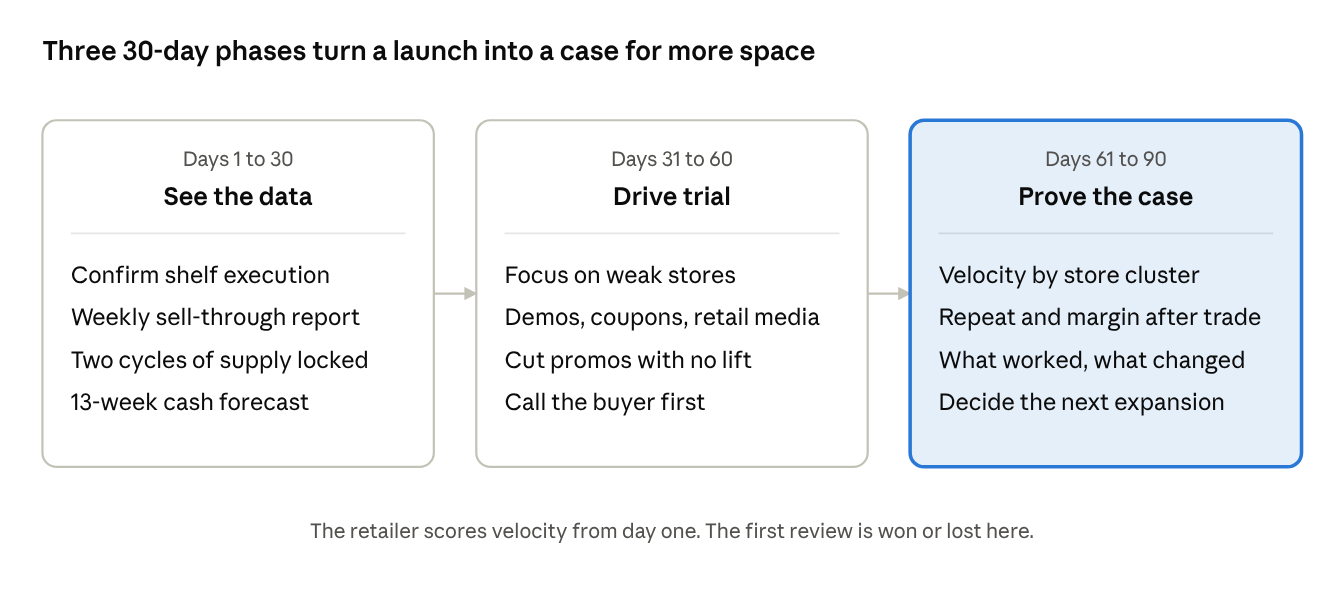
Days 1 to 30: Get on shelf and see the data
The goal of the first month is clean execution and clean information. Confirm that product is actually on shelf in every store on the planogram, priced correctly and in the right spot. Set up a weekly sell-through report by store and by SKU, and decide who owns it. Lock in a supply plan for the next two replenishment cycles, with a named backup for your most fragile ingredient or component. Agree on a 13-week cash forecast with your finance lead so nobody is surprised.
Days 31 to 60: Drive trial where you are weakest
By week five you will see a spread. Some stores and regions will be selling well and some will be close to zero. Resist the urge to spread marketing evenly. Focus trial programs, demos, digital coupons and retailer media on the stores with weak velocity but good shopper demographics for your product. Review every promotion against the lift it produced, and stop the ones that did not move units. Talk to your buyer before they call you, with your own read on the numbers.
Days 61 to 90: Prove the case for more space
The third month is about building your story for the next review. Pull together velocity by store cluster, repeat purchase where you can measure it and the margin you are earning after trade spend. Show the buyer what is working and what you changed. Use the same numbers to decide your own next move: which retailer to add next, which SKU to cut and whether your supply chain and cash can support another expansion. A brand that walks into its first review with this level of clarity is far more likely to earn more shelf space than one that walks in with a story.
Where a fractional COO or CMO fits after a national launch
A fractional COO or CMO is often the right hire for the 90 days after a national launch, because the brand needs senior operating judgment right now but cannot yet justify a full-time executive. The work is intense, specific and time-bound. That is exactly the shape of a fractional engagement.
A fractional COO typically owns the supply plan, the cash forecast, co-manufacturer and logistics relationships and the weekly operating rhythm. A fractional CMO typically owns the trial plan, retailer media, trade promotion discipline and the shopper story in new markets. In many emerging brands, one experienced operator can cover both, because the decisions are so tightly linked. Every promotion is a marketing choice and a cash choice at the same time.
The point is not to add another layer. It is to give the founder a partner who has seen this movie before and can build the machine while the founder keeps selling. When the business is ready for a full-time leader, a good fractional executive hands over a working system, not a stack of slides.
This is also the moment when acquirers start paying attention. This same week, Stride acquired Clio, whose Greek yogurt bars are in 60,000 stores (Nosh, October 4, 2026). Brands that show steady velocity, healthy margin and a team that can run the business are the ones that get those calls.
Frequently asked questions
What is retail velocity and why does it matter?
Retail velocity is the number of units a product sells per store, per week. Retailers use it to decide which products keep their shelf space and which get cut at the next category reset. Strong distribution with weak velocity is one of the most common reasons emerging brands lose national accounts.
How long does a new CPG brand have to prove itself at a national retailer?
Most brands get roughly one review cycle, often six months to a year, before a retailer decides whether to keep, expand or cut the item. The data the buyer sees in the first 90 days shapes that decision, which is why the early weeks matter so much.
Why do new consumer products fail after landing distribution?
Research on more than 83,000 new CPG products found that one in four is no longer bought after a year. The most common causes are operational: out-of-stocks, cash shortfalls, undisciplined trade spending, weak consumer pull in new markets and a team that is not set up to run a national business.
When should a food or beverage brand hire a fractional COO or CMO?
A common trigger is the moment a brand signs its first national or multi-region retail account. The brand suddenly needs senior experience in supply chain, cash management and trade marketing, but usually is not ready to add a full-time executive salary.
What should be in a 90-day plan after a national retail launch?
A strong plan covers three phases: confirm shelf execution and set up weekly sell-through data in the first 30 days, focus trial programs on the weakest stores in days 31 to 60 and build the case for more space with velocity, repeat and margin data in days 61 to 90.
The launch is the starting line
Landing a national retailer is one of the best days in the life of a consumer brand. Treat it as the start of a 90-day operating sprint and you give that win the best chance of becoming a business. Treat it as the finish line and the data will make the decision for you.
If your brand just landed a national account, or is about to, I would be glad to talk through what your first 90 days should look like. Start the conversation here.
Marc Drucker is a fractional CEO, COO and CMO who helps food, beverage and consumer products companies turn growth into a business that lasts. He is the author of “How Leaders Fuck Up Innovation.” Learn more at marc-drucker.com.
Prefer a quick visual breakdown? Download the flip-book version of this 90-day plan below.