Ask a founder when someone should drink their new beverage, and you will often hear the worst answer possible: “Anytime.”
This just happened to me, again. I recently met with a very successful entrepreneur, someone who has grown and sold multiple businesses, but never in CPG. To him, “anytime” sounded like the holy grail. Who wouldn’t want to market a drink people can have morning, noon or night? One that is as perfect before the gym as it is after, and as good alone as it is with friends? It makes for great numbers in the projections. But, in practice, it will mean there is no market at all.
I have watched good products with great packaging and real retail wins fade within a year for exactly this reason. Trial was strong. Demos went well. Then repeat purchase never showed up, because the shopper liked it but had no idea when to reach for it again. The product was not the problem. The missing answer to “when?” was.
Every successful beverage brand has a very clear drink occasion. Red Bull gives you wings: energy when you need it. Coconut water and Pricklee are healthy hydration when you are thirsty. Coke, Pepsi and Poppi are for when you want refreshment. Even brands in the same category have clearly defined occasions: Stella Artois is for dinner out, Michelob Ultra for active socializing, Budweiser for watching the game and Bud Light for casual get-togethers.
If you think this is only a startup problem, look at Zevia. It invented the better-for-you soda aisle in 2007, then watched Olipop and Poppi run past it. Last month it took a $20 million investment to fund a strategic reset, and one of the stated priorities is to “expand into new occasions” (Food Dive, October 26, 2026). Nearly two decades in, it is still working on the question.
A beverage that lacks a purpose lacks a market. Every food and beverage brand needs a clear answer to when, exactly, someone reaches for it. A new brand needs it more. A new brand that does not fit neatly into an established category needs it most of all.
“Health-conscious millennials” is not an answer
When I ask leadership teams what their drink is for, they often tell me who it is for: health-conscious millennials, busy moms, active Gen Z. Those people drink dozens of different things every week. Naming them tells you almost nothing about when they would choose yours.
An occasion is a moment, and it has four parts:
- Who is drinking it
- What need it meets in that moment
- When and where they drink it
- Why they choose it, and what they would have drunk otherwise
“The 3 p.m. slump at a desk, when someone wants a lift but does not want a third coffee or another soda” is an occasion. In one sentence it tells you who you are competing with, what size and temperature the product should be, where it needs to be sold and what the marketing should say.
Why occasions matter more than categories
Shoppers do not wake up wanting a category. Nobody thinks, “I would like a functional beverage.” They think, “I need something to get me through this afternoon,” or “I want something to hold at this party that is not a beer.” The category is how the industry organizes the shelf. The occasion is how people actually decide.
That difference shows up in every part of a business.
It shapes the product. A drink for the morning commute, a drink for after a workout and a drink for a dinner party need different pack sizes, sweetness levels, caffeine levels, temperatures and price points.
It shapes distribution. An occasion tells you where the product needs to be: the cold box at a convenience store, the gym, the office, the grocery set, the bar. Being sold in the wrong place for your occasion looks like weak demand, but it is really a distribution problem.
It shapes marketing. Marketing that names a moment is easier to remember and easier to act on than marketing that names a benefit. “Zero sugar” is a fact. “The drink you bring to the barbecue when you are the one driving home” is a reason to buy.
It shapes the conversation with retailers. A buyer’s first question about a new item is some version of “What does this replace, and why will it sell faster than what is already there?” An occasion answers that question.
Why this matters even more for a new brand
An established brand has years of memory working for it. People already know when they reach for Gatorade or a cup of coffee. A new brand starts with none of that, and it has to build it with a small budget, a few retailers and a short window before buyers decide whether it stays.
In my work as a fractional CEO, COO and CMO for food, beverage and consumer products companies, the launches I see struggle most rarely have a bad product. They usually have a product that is trying to be good for everyone, all day long, so it is not strongly linked to any one moment and does not come to mind in any of them.
A clear primary occasion does the opposite. It lets a small brand concentrate its spending where it can be noticed, show retailers a believable reason it will sell and give consumers a simple reason to buy it again. Once that first occasion is owned, adding a second one is far easier. Zevia’s current reset shows how much harder it is to add occasions after growth has stalled than to build them deliberately on the way up.
Why it matters most when you do not fit an established category
Some of the most interesting brands in food and beverage do not fit neatly anywhere: non-alcoholic beer and spirits, lower-caffeine energy drinks, prebiotic sodas, functional shots, hydration products that borrow from sports drinks, and now vodka ades that mix sports-drink flavors with alcohol.
When you do not fit an established category, three things get harder at once.
The shopper does not know when to drink it. A familiar category comes with familiar moments. A new one does not. If you do not tell people when your product fits, most of them will never figure it out, and the ones who try it once will not know when to buy it again.
The retailer does not know where to put it. A product that could live in soda, water, energy, wellness or beer often ends up in the set where it sells worst, or moves between sets from one retailer to the next. Every move resets the brand’s sales history and makes the numbers look weaker than they are.
Marketing lacks a consistent message. Without a clear occasion, marketing tends to tell several different brand stories. Each story might be reasonable on its own, but together they confuse everyone.
The brands that win in new spaces usually solve this by tying the new product to a moment people already understand. Athletic Brewing did not ask drinkers to understand a new category. It linked non-alcoholic beer to moments they already had: training, staying sharp the next morning, being present at a social event and Dry January (Drinks Intel, December 17, 2025). The category was new. The occasions were not.
Finding your drink occasion
The drink occasion sits at the intersection of three things: the consumer, their daily life and the product. Finding it means finding the center of that Venn diagram, and defining it is the ultimate expression of product-market fit.
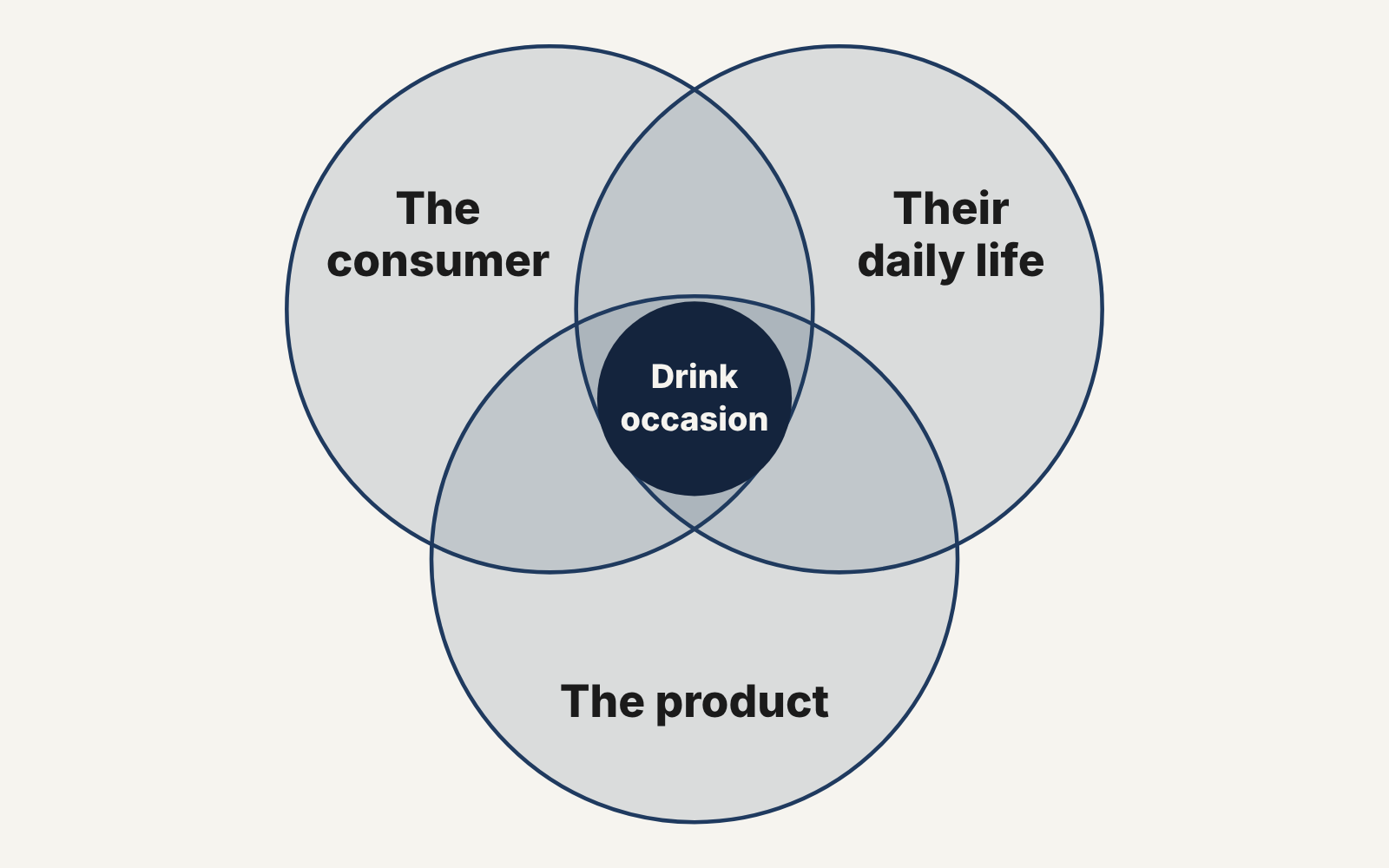
Most brands I work with find their real occasion is narrower and more specific than they expected, or wanted. Not every beverage brand is destined to become a billion-dollar business. Understanding your occasion is the most important step toward understanding your company’s real potential.
Once you have found it, four moves turn it into growth.
Choose one primary occasion
Pick one occasion to lead with. Judge each option against four questions: Is it big enough to build a business on? Does the product truly fit it better than the alternatives? Can a brand your size be noticed there? Does it happen often enough to drive repeat purchases? The best first occasion is usually not the largest one. It is the one you can own.
Make the product fit the moment
Once the occasion is chosen, check that the product serves it. Pack size, temperature, caffeine level, sweetness, format and price should all make sense for that moment. Smucker did exactly this with Uncrustables this year. It did not change the taste. It made the frozen sandwich safe to keep in the refrigerator, so people can grab one on the way out the door instead of waiting 30 minutes for it to thaw. Its research found 72% of current users would eat it more often (Food Dive, October 26, 2026).
Let the occasion decide where you sell
Put the product where the occasion happens. A post-workout drink belongs near gyms and in the cold box. An afternoon pick-me-up belongs in convenience stores and offices. A social non-alcoholic drink needs bars, restaurants and the beer and wine aisle. Use the occasion to make your case for set placement with each retailer, and push to sit in the same set everywhere so your sales history builds instead of resetting.
Make marketing name the moment
Every piece of communication should make it easy to picture when to drink the product. Show the moment, not just the bottle. Sample at the moment, not just in the store: in the gym, at the office, at the event. Repeat the same moment long enough for it to stick. A small brand will not win by saying many things to many people. It wins by saying one thing, over and over, to the people who have that moment.
What a fractional executive does in the first 90 days
When a growing brand brings me in to sharpen its occasion strategy, whether before a launch or after one has stalled, the first 90 days usually look like this:
Days 1 to 30: Find the truth. Interview repeat buyers, lapsed buyers and retail buyers. Pull velocity by retailer, set and region. Ask every leader to write down the brand’s occasion, then compare the answers.
Days 31 to 60: Choose and align. Agree on one primary occasion and at most one secondary occasion. Check the product, pack and price against it. Rewrite the sales story and the retailer pitch around it, so everyone is telling the same story.
Days 61 to 90: Put it in market. Shift sampling and media to the chosen moment, move distribution priorities toward the channels where that moment happens and set up a simple scorecard: repeat rate, frequency and velocity in the focus channels.
This work cuts across product, sales, marketing and operations, which is why it often stalls inside a growing company. Each team owns a piece, and nobody owns the whole answer. A senior leader who works across all of them can settle it quickly.
Frequently asked questions
What is a drink occasion?
A drink occasion is the specific situation in which someone chooses a beverage: who is drinking, when and where, what need the drink meets in that moment and what it replaces. Examples include the afternoon slump at work, the drive home from the gym and a dinner party where someone is not drinking alcohol. Occasions are more useful than demographics because they describe a buying decision, not just a type of person.
Why do new beverage brands need a clear occasion?
New brands have no existing memory working for them, a limited budget and a short window to prove themselves to retailers. A clear primary occasion lets a new brand focus its spending, explain to buyers why it will sell and give consumers a simple reason to buy again. Brands that try to fit every moment of the day usually do not become strongly linked to any of them.
How does a brand that does not fit an established category choose its occasion?
Tie the new product to a moment people already understand rather than asking them to understand a new category. Athletic Brewing, for example, linked non-alcoholic beer to training, social events and Dry January. Map the occasions where current buyers already use the product, choose the one the brand can own and make product, distribution and marketing decisions around it.
When should a food or beverage brand expand into new occasions?
Expand after the brand clearly owns its first occasion, shown by strong and stable repeat purchase, purchase frequency and velocity in the channels that match that occasion. Expanding too early spreads a limited budget across too many moments. Expanding too late, after growth has stalled, is harder and more expensive.
Own a moment before you try to own a category
The brands that grow fastest in food and beverage are rarely the ones with the longest list of benefits. They are the ones that come to mind at a specific moment in someone’s day. For a new brand, and especially for one that does not fit neatly into an established category, that clarity is not a marketing detail. It decides what you make, where you sell it, what you say and how you measure success.
If you are launching a new brand, or your brand has strong trial but weak repeat and you suspect the occasion is the problem, I would be glad to talk it through. Start the conversation here.
Related reading: Challenger to Category Leader; Subtraction Is a Growth Strategy; and How to Compete on Value Without Becoming a Discount Brand.
Marc Drucker is a fractional CEO, COO and CMO who helps food, beverage and consumer products companies turn growth into a business that lasts. He is the author of “How Leaders Fuck Up Innovation.” Learn more at marc-drucker.com.