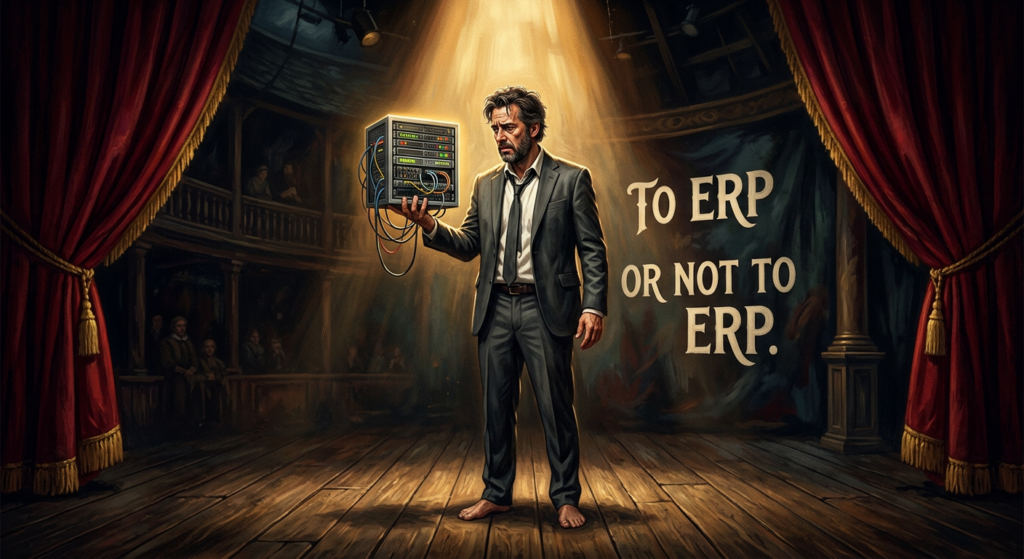
If there’s one thing I’ve learned about integration projects, it’s that every one eventually leads to the same predicament: to ERP or not to ERP, that is the question.
It starts focused. An inventory tracker. A marketing dashboard. Something specific and contained.
Then the requirements get mapped out and the scope grows. More data sources. More connections. More automation.
By the time the list is finalized, the answer is always an ERP. NetSuite. Dynamics. Plex. Something that costs six figures and takes a year to stand up.
This is simply not the right answer for a SMB. Too slow to implement, too expensive to maintain, too complex to manage, and more important than all that, too inflexible, requiring the company to work the way the ERP is designed instead of designing the ERP around the way the business works.
SMBs can move quicker and more effectively when they begin with the assumption they need integrated outputs, which, despite what the big ERP vendors will tell you, does not require integrated data.
Integrated data means every system talks to every other system in real time. That’s what an ERP does, and it’s expensive because it’s genuinely hard.
Integrated outputs just means: can leadership see the data it needs to make a decision in one place?
That’s a different problem. A much more straightforward and appropriate one.
A well-built BI (Business Intelligence) dashboard solves it. The outputs from each system get pulled into one view without requiring the systems to talk to each other. No migration. No implementation partner. No 18-month timeline.
Add an AI agent on top to interpret the outputs and it gets really interesting. Instead of a team staring at numbers trying to connect the dots, the AI does it. It finds correlations across data sources no one thought to compare. It flags what changed week to week and why it might matter. It surfaces what was buried in row 400 of a spreadsheet and would have stayed there.
And it explains all of it in plain English. Not a chart that requires interpretation. An actual answer to the question leadership was trying to ask.
SMBs have traditionally been caught in the middle. Too small for an ERP to make sense, too big to keep living with disconnected solutions. AI changes that. Smart dashboards bridge the gap between unconnected systems, and continuous intelligent analysis delivers the kind of insights that used to require an ERP to surface. The middle ground finally has a solution.