The Meeting Everyone Hates Might Be Your Most Powerful Business Tool
When someone schedules yet another recurring meeting, at best most people’s first instinct is to groan. At worst they see it as a sign of bureaucracy that’s going to slow everything down and eliminate creativity and initiative, at best it’s taking time away from ‘real work.’ Routines are seen as time sinks, duplications, interruptions and a symptom of micromanagement.
But after years of building and scaling teams, I’ve come to believe the opposite: a well-designed meeting cadence isn’t just useful, it might be the single most critical operating system in a high-performing organization.
The key words are ‘A well designed cadence.’ Not one meeting, but a rhythm of defined team communications, collaboration and assessments that speed decision-making, give time back to the team and assure work is aligned with goals in real time.
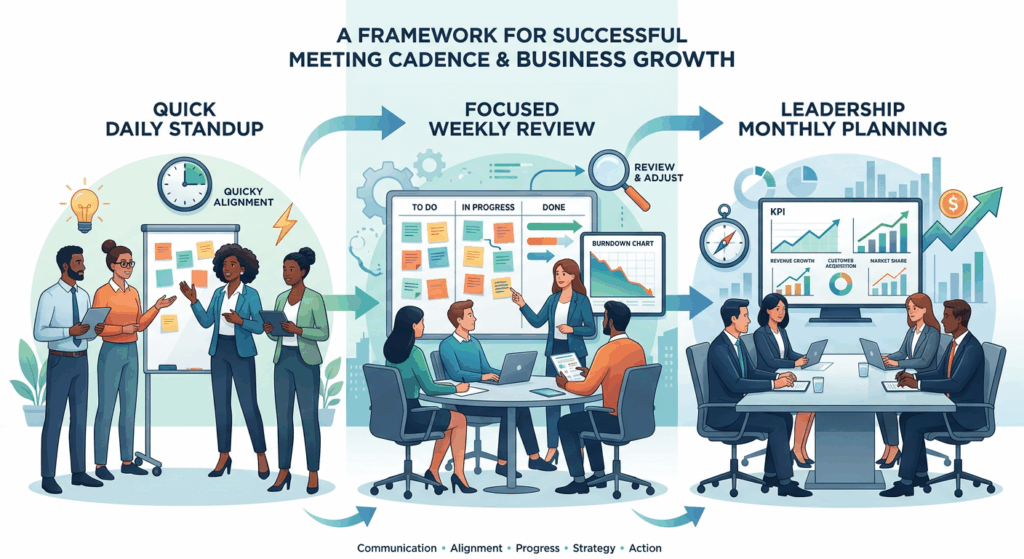
My preference is to structure operations around 3 very different meetings; 15 minute daily standups, 1 hour weekly project planning and 2 hour monthly KPI reviews and planning.
The 15 Minute Daily Standup: Operations Pulse Check
A daily standup includes everyone on the functional team, from interns to senior leadership, to keep it quick (ideally 15 minutes or less) everyone actually stands up and each person answers these three questions:
- What did you accomplish yesterday?
- What are your goals for today?
- What obstacles are in your way, and what do you need to move past them?
Yesterday’s accomplishments create accountability without bureaucracy. Today’s goals force real-time prioritization. Obstacles are leadership’s mechanism for “waterfalling” problems upward before they become crises. Daily scrums enable frontline teams to escalate issues to leadership fast and informally, enabling leadership to stay connected to what’s happening on the ground. The daily standup is leadership’s heartbeat of the business.
The Weekly Project Review: Progress to the Goal
Once a week, zoom out and focus on making sure every project is moving forward. Project management is critical in every organization and a weekly review with project managers give the function the attention it deserves from leadership.
A well-run weekly project review gives every initiative a clear status, on track, at risk, or stalled. It surfaces dependencies, bottlenecks, and deadlines before they sneak up on the team. And it creates a natural forcing function for project owners to prepare, communicate progress (or lack thereof) and address concerns before they compound.
This is a focused check-in with the team leads and project mangers on project execution. What’s moving, what’s stuck and what needs attention this week.
The Monthly Review: The Scorecard and Navigation System
The monthly review is your scorecard and navigation system. It does two things. First, it takes an honest look at progress toward your KPIs with enough clarity to determine if the team is on track to hit their targets, or not.
Second, it looks ahead. A disciplined review of the next 30 to 60 days of the calendar, key deadlines, launches, hiring milestones, client commitments, ensures the team isn’t just reacting to what’s in front of them. It creates space to reallocate resources, resolve conflicts, and make proactive decisions before urgency forces your hand.
This is also where leadership and frontline teams recalibrate together. Strategy and execution drift apart quietly. The monthly review is how you catch it before the gap becomes a problem.
Why the Cadence Matters More Than Any Single Meeting
The power isn’t in any one meeting. It’s in the rhythm. Daily keeps you honest. Weekly keeps you on track. Monthly keeps you pointed in the right direction.
Together, they create something many small and mid-sized businesses lack: a structured, disciplined communication system that connects the ground-level reality of execution to the long-term vision of leadership.
Routines aren’t glamorous. They won’t make the highlight reel. But the businesses I’ve seen who prioritize their routines execute consistently.
What does your meeting cadence look like? I’d love to hear what’s working — or what you’re still trying to figure out.
Written by: Marc Drucker, Fractional CMO/COO
Read more at: www.marc-drucker.com
Schedule time to connect: https://bit.ly/MarcDrucker-Calendly
#marketing #operations #cpg #consumerproducts #appliances #innovation #innovationmanagement #innovationsystems #consumerinsights #consumerresearch #timetomarket #designthinking #productmanagement #Agile #Scrum #collaboration #CMO #COO #CEO #fractional #fractionalCMO #fractionalCOO #decisionmaking #leadership